
Typical Kraft Pulp Mill Chemical Processes
Kraft pulp mills, which are comprised of many internal processing plants, recover and regenerate the chemicals needed to extract cellulosic fiber from raw materials. One of the chemicals needed to produce cellulosic material is sodium hydroxide, NaOH. NaOH is spent (consumed) in the fiber liberation phase in the cooking plant during the creation of pulp from wood and other sources (aka digesting).
Regeneration of Sodium Hydroxide
The pulp mill recovery plant converts the spent NaOH to sodium carbonate (Na2CO3). The recausticization plant then converts the Na2CO3 back to NaOH (regenerated NaOH) using hydrated (slaked) lime, Ca(OH)2, simultaneously producing calcium carbonate (lime mud CaCO3) as a byproduct. The byproduct CaCO3 is commonly referred to as ‘lime mud’. In essence, the Na and Ca transport the active cooking chemicals and byproducts (oxides, hydroxides and carbonates) and allows them to trade places in the recausticization step. Most mills have a calcining plant which uses a lime kiln fired with fossil fuels to burn the lime mud CaCO3, thereby liberating CO2 and regenerating lime (quick lime), CaO. The CaO is then available for rehydrating (slaking) to Ca(OH)2 which is needed in the causticization step. These processes complete closed chemical loops with only small losses of Na and S in the cooking phase (due to the adherence of Na to the cellulosic fiber exiting the cooking plant) and other areas of the mill, which is replaced as ‘makeup’ in the recovery plant using saltcake, Na2SO4.
Types of Calcium Carbonate
There are several types of crystal morphologies that CaCO3 can form due to the permutation of the locations of the five atoms. The different morphologies create crystals of various sizes and together with the size and crystal pattern, have different normalized surface areas. The different surface area, sizes and reflective surfaces all have an effect on the commercial value of the CaCO3 morphology in question.
Definitions – Calcium Carbonate
Morphology – structures that change (morph) into other structures due to conditions of heat, temperature, and pressure. This implies that some of the crystal structures are transient and not the most stable form. In the case of CaCO3, the chemical kinetics prefers the aragonite morphology (ie it is easily and quickly formed), but the most stable form is the thermodynamically favored morphology called calcite. Marble would be an example of the thermodynamically favored calcite morphology.
Aragonite – CaCO3 derived from natural earth formations and synthetic generation. For example, shellfish deposits are of the aragonite morphology. The natural formations generally include silica which is abrasive to machinery. This morphology has some commercial value and is the kinetically preferred structure.
Calcite – CaCO3 derived from earth formations subject to time, temperature and pressure. It is also generated synthetically under controlled conditions to create a crystal shape of interest (eg rhombohedral, scalenohedral) with uniform size, and high whiteness and purity. Calcite is referred to as PCC when generated synthetically and GCC when derived from natural formations (see definitions below). The natural formations may include silica which is abrasive to machinery. This morphology generally has a higher commercial value than aragonite, and is the thermodynamically stable structure.
Chalk CaCO3 (also in this report referred to as ‘chalk’) – Calcite CaCO3 with a low commercial value morphology, low whiteness and large particle size. It usually contains silica which is abrasive to equipment.
Lime Mud CaCO3 (also in this report referred to as ‘lime mud’) – Aragonite CaCO3 with low commercial value due to low value morphology, large particle size and particle size distributions, low whiteness, and chemical contamination. It is a by-product of the chemical pulping processes.
PCC CaCO3 (also in this report referred to as ‘PCC’) – Calcite CaCO3 with high commercial value due to high value morphology (calcite), small particle size, low particle size distributions, high surface area, high whiteness and purity. It is typically made in specially designed chemical plants from high quality raw materials.
GCC CaCO3 (also in this report referred to as ‘GCC’) – Calcite CaCO3 from natural deposits having some commercial value due to better properties relative to chalk. However, the properties are less in quality relative to PCC. Additionally, the particles are more abrasive than PCC due to silica, which creates excessive wear on process equipment.
Kraft Mill Process Plants
In summary there are two pulp mill closed loop chemical processes. They are comprised of the following ‘Steps’ which occur in several internal processing plants that comprise a kraft pulp mill:
- Cooking – NaOH (a constituent of white liquor) is used to liberate cellulosic fiber from the raw material creating spent NaOH (a constituent of black liquor)
- Recovery – spent NaOH (a constituent of black liquor) is converted to Na2CO3 (a constituent of green liquor)
- Causticization – NaOH (a constituent of white liquor) is regenerated from Na2CO3 (a constituent of green liquor) creating a precipitated byproduct, lime mud CaCO3
- Calcining – the causticization byproduct, lime mud CaCO3 is converted to quick lime, CaO, by heating in a kiln
- Slaking – quick lime, CaO, from the kiln is hydrated (slaked) to form calcium hydroxide, Ca(OH)2, for use in the causticization of Na2CO3 (step 3)
Kraft Mill Chemical Loops
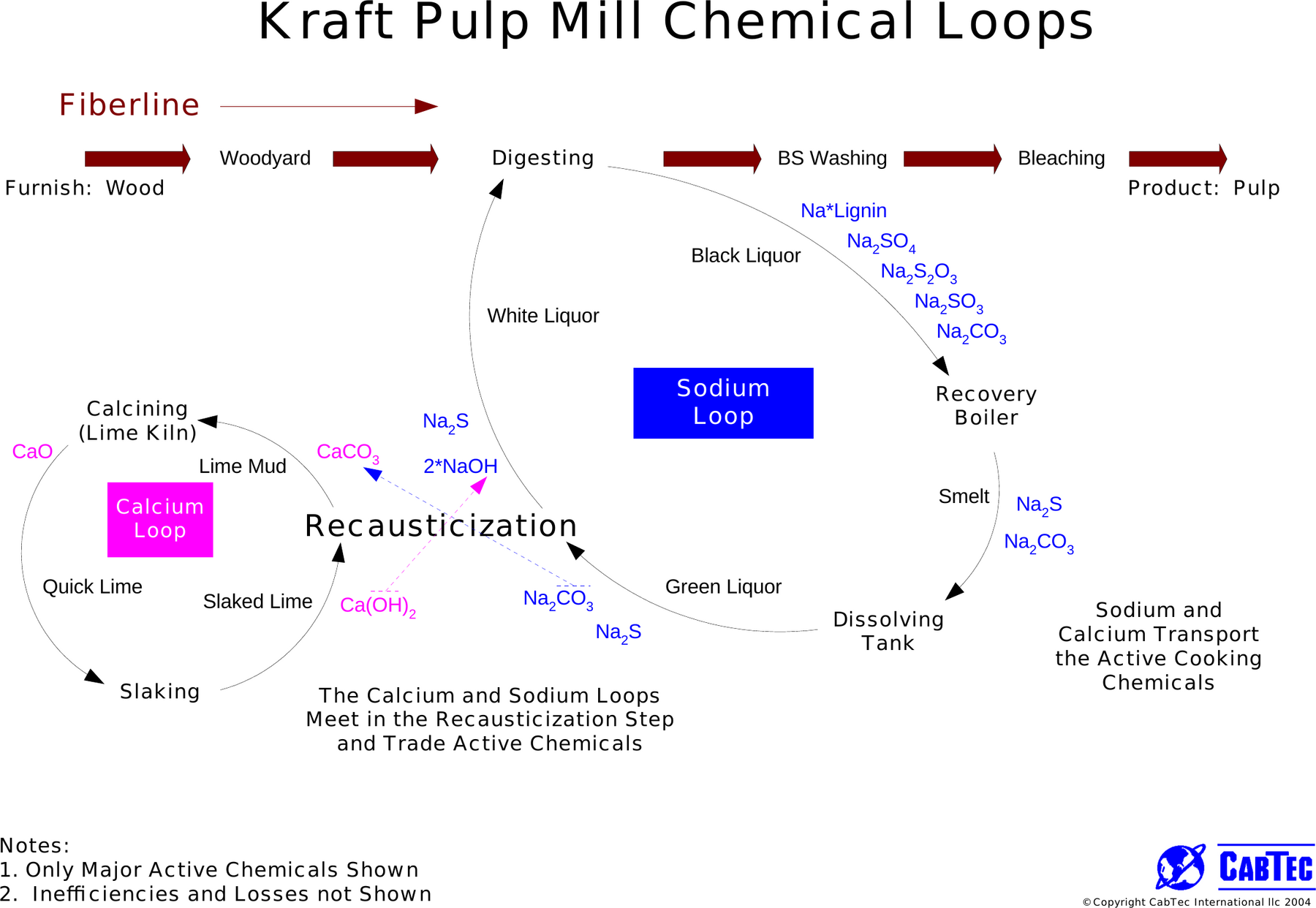
The processing steps described above form two closed loops with respect to the major atoms used in kraft pulp mills. The main chemical loop is based on the sodium and sulfur atoms. The second loop is based on calcium atoms. The sodium and calcium atoms transport the active molecules required for kraft pulp reactions. The two loops are comprised of the steps noted above in the following arrangement:
- Main consumption loop (Na loop – steps 1, 2, 3, 1, . . .) - black liquor to green liquor (in the recovery step 2) to white liquor (in the causticization step 3) back to black liquor (in the cooking step 1), etc.
- Support regeneration loop (Ca loop – steps 3, 4, 5, 3, . . .) - lime mud CaCO3 to CaO (in the calcining step 4) to Ca(OH)2 (in the slaking step 5) back to lime mud CaCO3 (in the causticization step 3), etc.
Kraft Mill Calcium Carbonate
The kraft chemical processes create calcium carbonate which is insoluble and therefore, precipitates out of solution. Technically, this is precipitated calcium carbonate. However, commercially it is not referred to as precipitated calcium carbonate (PCC) because of the low commercial value due to large and inconsistent size, low whiteness and purity. The reaction of interest for the formation of calcium carbonate (CaCO3) occurs in the common recausticization step 3. The chemical equation is:
Ca(OH)2 + Na2CO3 ≈ 2 NaOH + CaCO3 ↓
NOTE: This equation is an equilibrium equation which does not have 100% conversion at the normal conditions as operated in the pulp mill
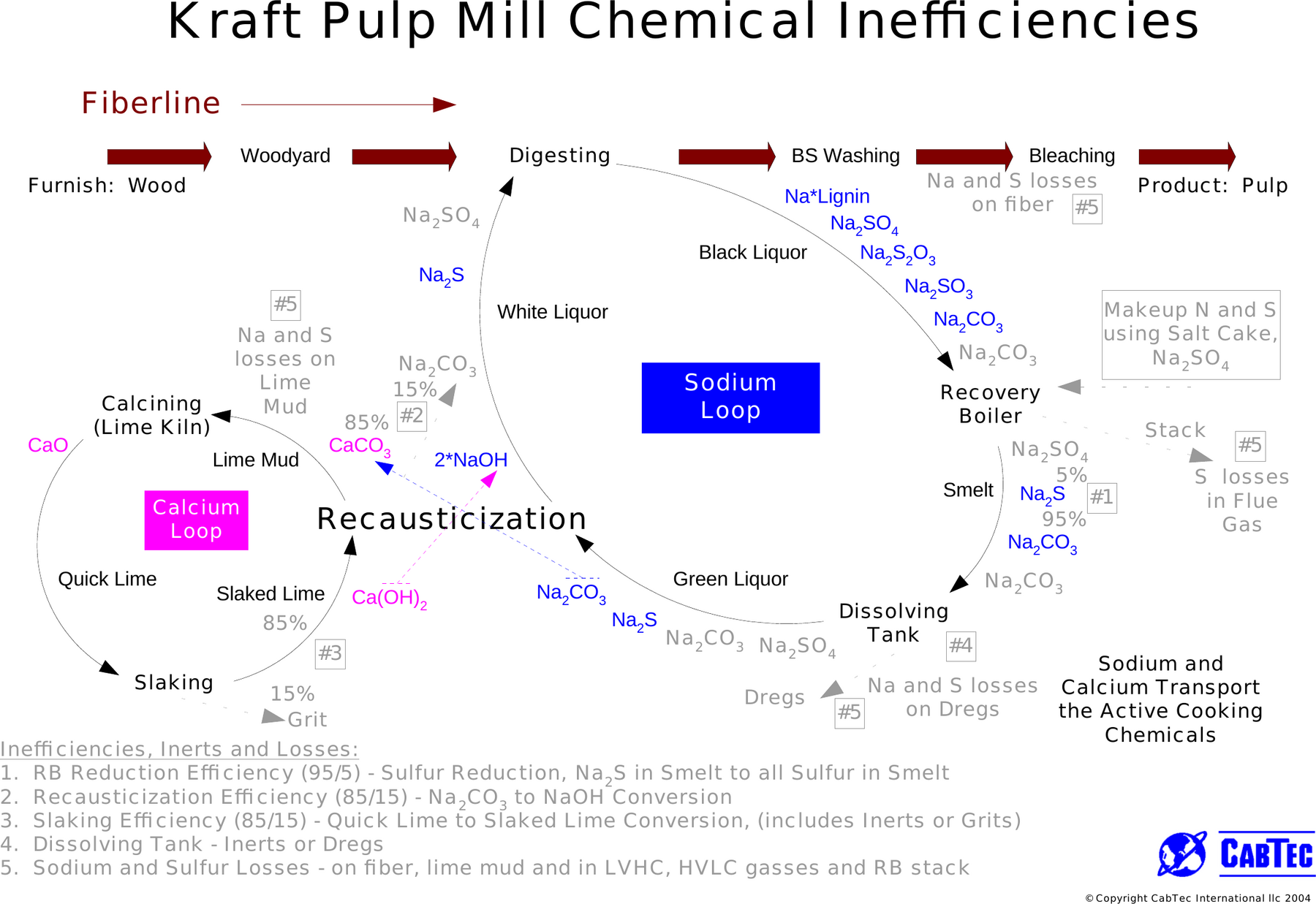
The following Figure 1 - Typical Closed Chemical Loops and Figure 2 - Closed Loops with Losses diagram the above discussion. Figure 1 - Typical Closed Chemical Loops is a general arrangement overview. Figure 2 - Closed Loops with Losses indicates where the sodium and sulfides are released into the environment.
NOTE: The cost of fossil fuel to heat the kiln, remove excess water from the lime mud, and provide the endothermic heat of reaction to drive off the CO2 (Hrxn = -1385 BTU/lbm CaO) versus the cost of purchasing lime (quick lime) commercially made using coal as well as the cost of landfilling lime mud CaCO3 will dictate the decision to install a lime kiln closing the calcium loop. Initial capital costs for the lime kiln and associated equipment also have to be factored into the decision.
Pulp Mill Lime Mud
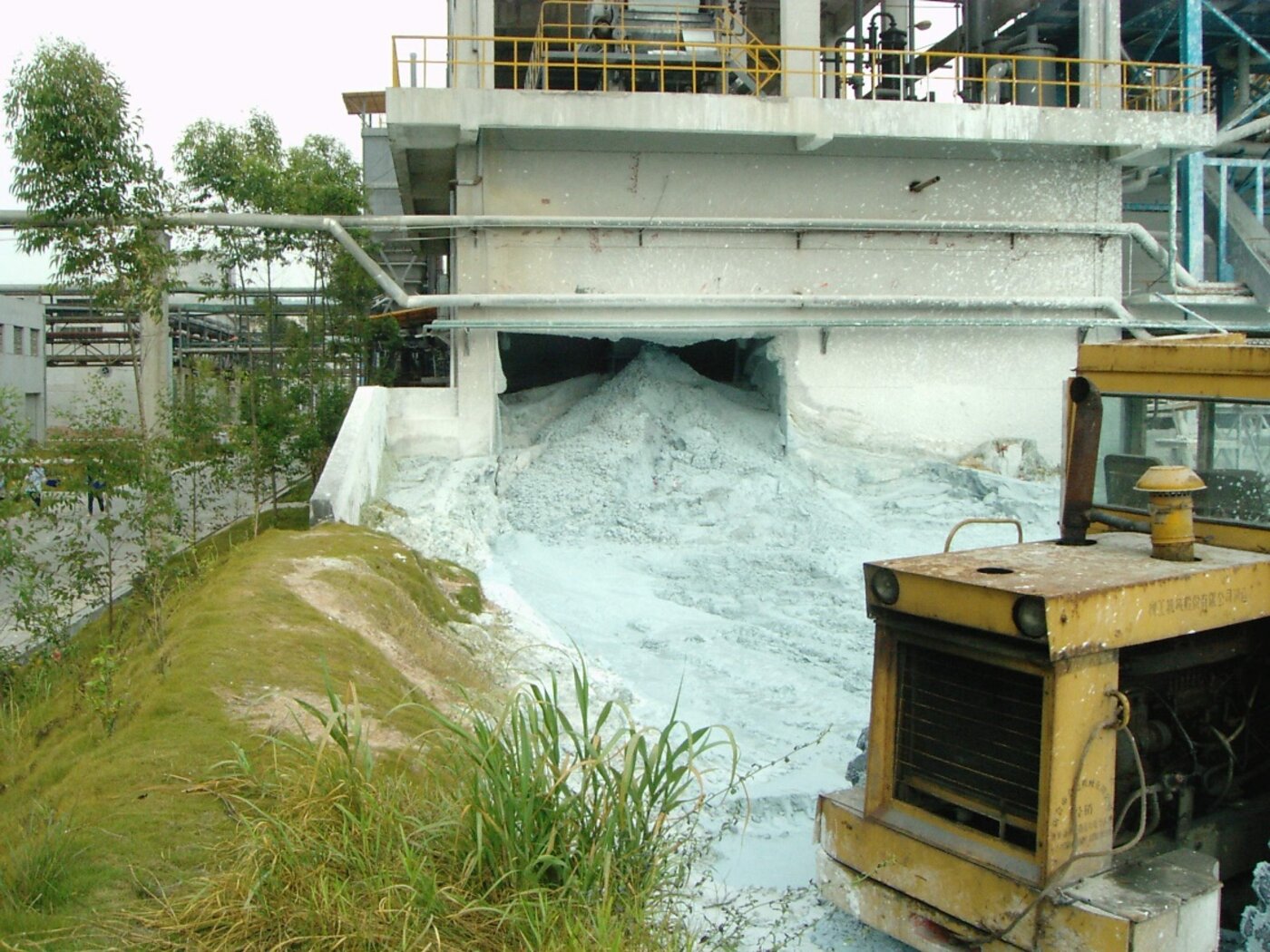
The lime mud CaCO3 precipitated from the pulp mill process has low economic value. It has a dull greenish color, sulfurous odor, and is a particle size of several microns. The particle size is similar to ground limestone but cannot compete commercially with virgin ground limestone prices. The only known commercial use is as an admix for cements or asphalts. Transportation costs are typically more than for what it can be sold in the market.
PCC – Precipitated Calcium Carbonate
Commercial PCC CaCO3
There are several types of CaCO3 morphologies with a smaller (submicron) crystallite particle size and higher market value. These are categorized and commercially sold as PCC (precipitated calcium carbonate). PCC is usually generated commercially by using a high-grade commercial lime and CO2 in the proper conditions to create the particle size and morphology desired. Typical commercial calcite products are scalenohedral and rhombohedral morphologies with a crystallite particle size of 0.4 to 0.6 microns and 0.07 microns respectively. Note that the lime mud CaCO3 from the recausticization process precipitates out of solution and therefore, is technically precipitated calcium carbonate. However, since it is not of the higher valued submicron crystallite morphology, it is not called PCC in the marketplace. Using a high grade commercial lime allows for better control of the reaction to produce the preferred morphology, and eliminates contaminants which create a higher product grade. PCC is used in the paper, plastic, paint, PVC plastisol, caulk/sealant and other industries. For example, the scalenohedral calcite morphology adds substantial opacity and bulk to finished white paper. Another example is the smaller sized rhombohedral calcite morphology being used in the plastics industry as a low cost filler, thixotrope, and/or impact modifier.
Commercial PCC CaCO3 Generating Plants
PCC satellite plants have been built around the world adjacent to paper mills to supply onsite PCC to host mills and additionally supply other local mills. The CO2 used in the PCC manufacturing process is recovered from the recausticization or recovery process’ lime kilns, power boilers, or other mill flue gases. The PCC generation requires shipment of lime to the satellite plant, special equipment for slaking and carbonating, and substantial blower capacity and mixer energy input. The process is energy intensive as the CO2 content of the available gases is usually low (12-28 percent) with no more than an 80% recovery. Several patents as well as a patent for continuously manufacturing PCC (Japanese, Hakuenka) have been mentioned in the literature, but almost all take advantage of the generation of PCC from the addition of carbon dioxide to a milk of lime solution. Another published article shows interest in generating white PCC from lime mud by wet-air oxidation of the impurities and sodium sulfide; however, it indicates a general failure as the whiteness of the product is still poor.
GCC CaCO3 and Chalk CaCO3
PCC’s advantages over ultrafine ground limestone, chalk, and ground limestone (GCC) are its whiteness, purity, and specific particle size/morphology.
Open Calcium Loop at Kraft Mills
China has substantial amounts of limestone mountains, especially in the southern part of the country. The limestone mountains are famously included in paintings, notably around Guilin City in Guangxi Province. Hence, the kraft mills in China, and specifically southern China, do not have lime kilns because the economics of operating a lime kiln with a hydrocarbon fuel relative to purchasing the lime. The local CaO suppliers, using coal as the heat source to calcine the limestone (CaCO3 to CaO), preclude the installation and operation of a lime kiln. Without a lime kiln, the calcium loop is open requiring the purchase of fresh lime and the landfilling of waste lime mud.
CPL Platey Process
CPL has developed a process to create high value PCC morphology, namely Rhombic and Platy. The modifications are done in the recausticization plant for open loop (non-regenerating CaO) mills. That is, pulp mills without lime kilns or other process to regenerate burnt lime (aka Calcium Oxide or Quick Lime). The Rhombic and Platy morphology are the highest commercial value CaO.