
Displacement Digester History
Origins of Displacement Batch Cooking
In the 1980's the Assi Doman mill of Sweden started experimenting with collecting the spent black liquors from the digester at the end of the delignification portion of the cooking cycle. This effort was the idea of Bertil Fagerlund, the mill manager. The removal of the thermal energy before the pulp stock was removed from the digester was performed with the hope of reusing the residual heat contained in the spent liquor for subsequent use in future cycles in order to save thermal energy. Bertil Fagerlund eventually filed for patents to cover the techniques to remove the hot spent liquor which included 1) unidirectional flow top-to-bottom, 2) unidirectional flow bottom-to-top, and 3) bi-directional flow of top and bottom to middles simultaneously. The technology patents were then acquired by the Rader company in Sweden. At that time, Rader was marketing a batch digester system called RDC an acronym for Rader Digester Circulation which allowed for steaming liquor to the top and bottom of the digester using a digester recirculation pump with an appropriate nozzle arrangement.
Initial Commercialized Displacement Technology, Late 1980's
The owner of Rader at that time, Rauma Repola of Finland, sold Rader to the Beloit Corporation in the USA with an agreement to retain the use of Rader's RDH (an acronym for Rader Displacement Heating) technology that was developed to that point in time. Simultaneously with the Rader activity, Sunds Defibrator of Sweden was developing and marketing a displacement technology under the name of 'Cold Blow' which was not successful due to insufficient storage of hot spent liquors (ie. too small storage vessels). Sunds Defibrator and Rauma Repola joined together after Rader was incorporated into Beloit. The retained use of the Rader RDH technology at Rauma Repola along with ideas from the unsuccessful Cold Blow system were marketed by Sunds Defibrator under the name of SuperBatch, who had become a subsidiary of Rauma Repola as noted above, after the sale of Rader to Beloit. Sunds Defibrator paid royalties to Beloit for all Superbatch systems sold for the use the Rader technology used in the Superbatch. The Beloit system, Rader's original system, was still marketed under the acronym RDH, but Beloit changed the reference to Rapid Displacement Heating.
Beloit RDH Commercialized Displacement Technology, Late 1980's
Eventually the method that was commercialized by Beloit to accomplish this was to displace the hot liquors in the digester uni-directionally from bottom-to-top with cooler weak black liquor from the brown stock washing plant before the pulp product was removed. The hot displaced liquors were stored in a tank farm that was comprised of pressure vessels and atmospheric tanks for reuse. The liquors were diverted to the different vessels in the tank farm according to their temperature.
Further RDH development by Beloit yielded modifications to their systems which were referred to by various titles such as: RDH Stage III, RDH IIIM, and RDH 2000 (RDH Stage II was the same as Superbatch and was abandoned by Beloit in 1991 due to inconsistencies in temperature, kappa, steam consumption, etc). Sunds Defibrator, today absorbed into the Valmet Company after several years as a Metso subsidiary, still produced systems under the name SuperBatch and now have changed the name to Ultrabatch, Optibatch and Superbatch-C. Other companies have also attempted this blend of batch cooking with recycle liquor management under different trade names (eg. EnerBatch and CBC from an Austrian company), but the DDS (with RDH lineage) offerings have been the most successful. It is interesting to note that no two of these installed displacement batch systems from any supplier are exactly the same, as each installation has had process modifications to enhance heat recovery, chemical recovery, chip impregnation, and production rates as the technical requirements and availability of capital have dictated at that installation.
Bertil Fagerlund, the inventor of kraft displacement digesters and the founder of CPL, Craig A Bianchini collaborated extensively to advance the RDH technology at Beloit. For example, in 1991, they invented the concept of White Liquor Profiling at an RDH swing furnish installation in South Carolina which was experiencing high levels of rejects during the softwood campaigns. Prior to this invention, essentially all the white liquor in displacement systems was introduced into the digester at the final hot liquor filling portion of the cooking cycle. This was causing the reject issue. White Liquor Profiling is the addition of the white liquor to create the most efficient use of EA in the digester according to the reaction rate. This is the basis of a CSTR (Back-flow) reactor, where one or more reactants and one or more products are continuously added and removed, respectively.
Basic Concepts of Displacement Digesters
Despite the various trade names and different supply companies, the basic concepts of displacement batch cooking are similar for all commercial offerings. That is, furnish (wood, bamboo, etc) is fed into the batch reactor (aka a digester), the furnish stays in the digester while various liquors from the tank farm are pumped through the bed of furnish which eventually becomes fiber, and lastly the product fiber is discharged to prepare the reactor for the next batch or 'cook'. The returned liquors from the digester that had been pumped through are stored liquors in the tank farm, having different characteristics of temperatures and residual kraft cooking chemicals. The stored liquors are used to heat or cool the furnish or fiber while exposing them to different concentrations of chemicals during the distinct steps of the cooking cycle. CPL's DDS™ is based on the same displacement technology, but has incorporated modifications that were discovered by CPL and others to create a more flexible displacement batch cooking system. The theoretical model that best describes the reaction kinetics is referred to as a CSTR (constant stirred tank reactor) or Back-Flow Reactor by chemical engineers and is not a simple 'batch' model due to continuous removal of by-products. This type of reactor has many benefits over the two other chemical reactor models: continuous (plug flow reactor) and batch (traditional batch reactor). Another way to look at the interaction of the reactants is to think of a fluidized bed.
RDH Displacement Technology Advanced
The hot stored liquors are then reused by pumping them into a newly furnish charged digester to start the 'cooking' to liberate the fibers. The primary goal of this additional equipment and complexity was to reduce energy costs, but serendipitously, it was discovered that there were other benefits to this method due to residual chemicals in the recycled liquors. These chemicals increased the selectivity of the cooking reactions which subsequently increased the pulp fiber strength while allowing the removal of more lignin from the furnish in the digester which is sent to the recovery island (i.e. cooking to a lower kappa number). This decreased the lignin removal requirement downstream in the brown stock ODL (oxygen delignification) and the bleach plant ultimately decreasing BOD effluent since bleach plant effluent is not in the recovery loop.
Digester Concepts
Conventional Batch Digesting
Conventional batch digesters (reactors) are operated in a start/stop batch scenario. That is, the reactants are put into the reactor vessel and allowed to react to produce a product, which is then expelled to complete a cycle. This operation is repeated ad infinitum to produce a product on a somewhat continuous basis. With reference to the pulp industry and in general, the reactor is the digester, the reactants are fiber bearing chips and white liquor, the product is the liberated fiber and the reaction by-products are the black liquors. The fiber is removed from the digester along with the black liquor. This mixture (referred to as stock) contains residual heat and unused chemicals which are not collected for further reuse.
Reactor Kinetic Comparison
Chemical reactions can be categorized by phase interaction (in increasing difficulty) as: gas-gas, gas-liquid, liquid-liquid, liquid-solid, and the typically the most difficult is solid-solid. Therefore, it can be seen that delignifying solid cellulosic material with liquid reactants is the second most difficult to accomplish. This puts great limitations on the interactions of the reactants (od wood and effective alkali, EA) in the reactor. The following table compares the three types of reactors and the effect on the reactants
| Kinetics Model | Commercialized as | od wood | EA |
|---|---|---|---|
| Batch | Conventional Batch | still | still |
| CSTR | Displacement Batch | still | moving |
| Plug Flow | Continuous | moving | moving |
The CSTR model utilizes the best attributes of each of the reactants: a still solid with a moving liquid
There are several benefits of a batch and CSTR reactor over a plug-flow reactor (aka continuous). One would be that if there is a problem in the continuous that requires downtime there will be no pulp produced while in the batch the other reactors will continue to produce pulp. Concerning the reaction, in a continuous reactor both the major reactants (wood and liquor) move normal to each other vs a CSTR which maintains the wood in one position while only the liquor has movement. An especially important distinction is if there is a delay downstream in the brown stock plant, the cooking reaction can be stopped in each CSTR individually by displacing the hot cooking chemicals when needed, thereby not destroying the pulp while the brown stock plant is down. The ability of batch and CSTR to accept non-perfect furnish is also well documented as there are many mills that need to screen the chips extensively for the continuous digester to not have internal liquor screen issues. These mills then feed the screenings from the wood yard to the batch digesters or displacement digesters.
Batch vs. Continuous Digesters
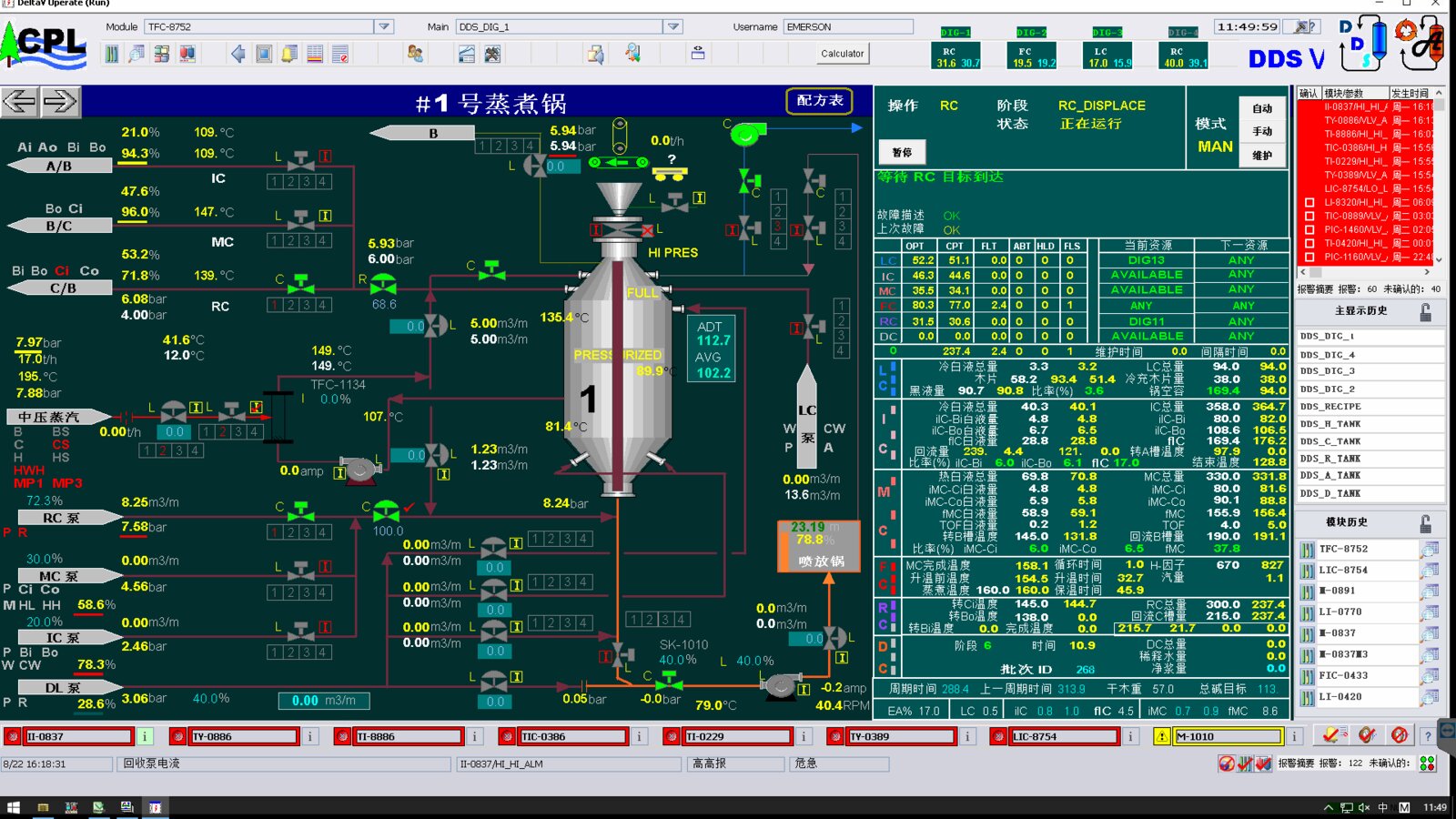
The advent of the electronic control and safety system in the 1980's referred to as the 'ICS' has enabled batch reactors to produce product on a continuous basis inherent in plug flow reactors which is commonly referred to as a 'continuous digester' in the pulp and paper industry. The Industrial Control System (ICS) is comprised of a DCS, interposing relays, safety directly wired redundant control relays, referred to as 'hardwired interlocks' (HWI), housing cabinets, UPS power, field instruments, etc.
Partial Heat Transfer Systems
Indirect Heat Transfer
CPL and other suppliers offer systems to transfer some of the heat using indirect heat exchangers as a less expensive investment. These systems do not allow for chemical benefits and the heat savings is much smaller than a full displacement process. The less efficient system offered by CPL is the DSS™ Cooking System. Heat is transferred using indirect heat transfer equipment from spent liquor to new charging liquor. There is no direct contact of the spent liquor which has substantial and important sulfidity for selectivity of delignification and residual OH⁻ which is the active species that solubilizes the lignin.
Direct vs Indirect Transfer
As described above, DDS is a direct contact displacement system which utilizes the chemical and thermal energy of spent liquors. The management of the liquors by the DDS far exceeds the other commercial systems thereby yielding a consistent stable production. The management of spent liquor to obtain residual heat is more difficult due to timing issues of individual digesters. CPL sold only one DSS system which was upgraded to a full DDS system due to inherent inefficiencies of indirect contact.